Affiliate note: Some booking links are affiliate links. If you book through them, we may earn a commission at no extra cost to you. Recommendations are selected for route fit, not commission.
The complete checklist in one screen
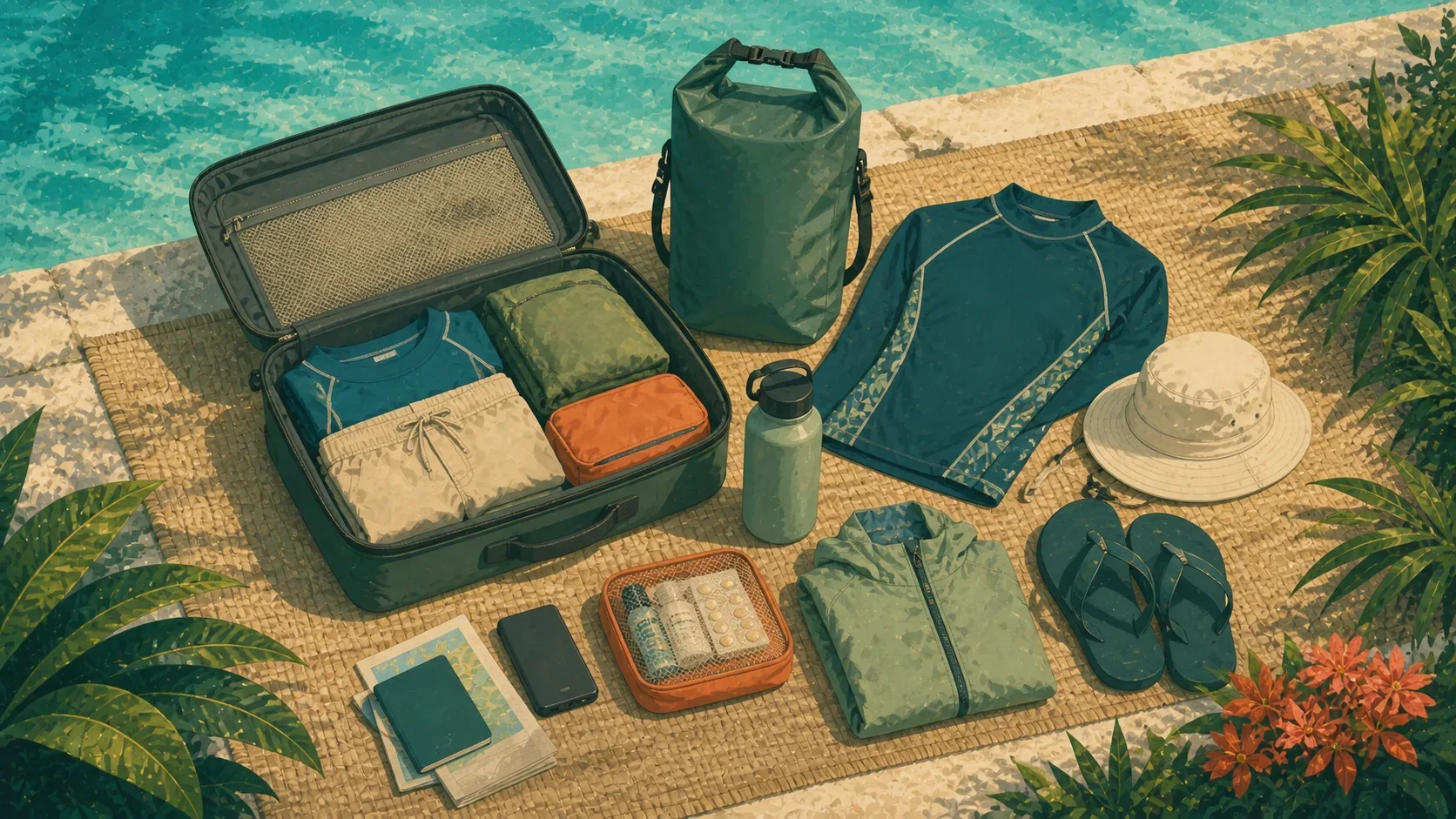
This list is a starting system, not a shopping order. Remove anything the accommodation reliably provides and anything you cannot carry comfortably through a ferry terminal, beach landing, or hotel stairs.
- Passport, entry documents, insurance details, and offline booking copies
- Payment cards plus a separated cash reserve
- Soft-sided main bag or manageable suitcase
- 10–20 liter roll-top dry bag for boat days
- Waterproof phone pouch with secure attachment
- Breathable shirts, shorts, swimwear, and one light long layer
- Rash guard or long-sleeve sun shirt
- Packable rain shell or poncho
- Secure sandals or water shoes plus light walking shoes
- Hat, sunglasses with retainer, and permitted sun protection
- Refillable bottle
- Personal medication and compact first-aid essentials
- Phone, compact charger, cables, adapter, and labeled power bank in carry-on
- Small laundry bag and a few reusable waterproof organizers
Use a two-bag system
The main bag holds clothing and items that can remain at the hotel. The dry bag holds what must survive a boat day: phone, money, room key, medication, a dry layer, and booking or identity copies. A waterproof pouch inside the dry bag adds redundancy for critical items.
A 10–20 liter dry bag is large enough for most day trips without becoming awkward on a crowded banca. Roll the closure correctly, keep sharp objects away from the fabric, and test it before trusting electronics. “Water resistant” and “submersible” are not the same promise.
Avoid a large hard suitcase when the route uses small ferries, vans, footpaths, or beach access unless wheeled convenience matters more. Check each domestic carrier’s size and weight rules before deciding.
Clothes that dry before the next island
Build around lightweight, quick-drying layers: several breathable tops, two or three bottoms, swimwear that can alternate, sleepwear, underwear, a light long sleeve, and one modest outfit for churches, cities, or a nicer dinner. Cotton is comfortable but slow when repeatedly soaked.
A rash guard reduces sun exposure and friction from life jackets. A thin sarong or travel towel can cover, shade, or dry, but never assume it replaces the operator’s safety equipment. Pack a small laundry line or a few clips only if the room setup makes them useful.
For ten days, pack roughly half a trip and plan one laundry cycle. More islands do not require more outfits; they require faster drying.
Footwear for wet landings and real streets
Secure sandals or water shoes help on rocky entries, boat ladders, hot docks, and slippery shallows. Flip-flops work around a hotel but can disappear in current or fail on rough access. Add one light closed shoe for city walking, airports, viewpoints, or trails.
Choose footwear already broken in. Salt, sand, and repeated wetting expose rub points quickly. Bring blister care if you are prone to it, and clean reef or mud residue before moving between sensitive environments.
Sun, heat, and rain belong in the same bag
Use shade and clothing first: brimmed hat, sunglasses, long sleeves, and a rash guard. Check current local rules and product ingredients before using sunscreen around reefs; “reef safe” is not a universally regulated guarantee.
Carry a compact rain shell or poncho even in a drier month. The aim is to keep a person functional during a transfer, not to make tropical rain impossible. Protect electronics and documents separately rather than assuming one jacket solves everything.
Heat can make an ordinary transfer exhausting. Refill water where safe, use oral rehydration products only as appropriate for you, plan shade, and listen to local heat and weather guidance.
Electronics and the power-bank rule
Bring the smallest useful set: phone, one compact charger, short cables, a plug adapter when required, and perhaps a camera only if it will genuinely be used. Download maps, reservations, insurance details, and essential contacts before leaving reliable data coverage.
CAAP guidance treats power banks as spare lithium batteries and prohibits them in checked baggage. Keep them in carry-on, protect terminals from short circuit, ensure capacity markings are legible, and check the airline’s current limits. Do not charge a device from a power bank during flight when the carrier or safety rules prohibit it.
Saltwater destroys equipment quickly. Use a lanyard or secure attachment around boats, rinse only according to the manufacturer’s instructions, and never open a wet housing beside exposed electronics.
Medicine and first aid without improvising
Carry personal prescriptions in original labeled packaging, plus enough for delays, and keep essential doses in hand luggage. Bring clinician documentation when required. A compact kit might include suitable wound cleaning, dressings, blister care, insect repellent, and medications already known to be appropriate for you.
Ask a clinician or pharmacist about vaccinations, motion sickness, allergies, sun sensitivity, and traveler’s diarrhea before the trip. Do not start unfamiliar medication based only on a packing article. Know where the nearest suitable clinic or pharmacy is in each base.
Travel insurance is not a medical plan by itself. Read how the policy handles water activities, diving, scooters, evacuation, pre-existing conditions, and documentation.
Documents, cash, and connectivity
Keep a secure offline folder containing passport identification, entry documentation, insurance, flights, ferries, hotel addresses, emergency contacts, and the map pins needed after arrival. Share an itinerary with a trusted contact without exposing sensitive copies unnecessarily.
Cards are useful, but small transport, fees, and outages make cash important on islands. Split it between secure locations and avoid carrying the entire reserve on a boat. Use official ATMs and review foreign transaction fees before travel.
An eSIM or local SIM can simplify arrivals and ride-hailing, but confirm device compatibility and coverage. Keep offline maps because mobile service can disappear exactly where a boat or road pickup needs coordination.
What belongs in carry-on
The Office for Transportation Security publishes prohibited-item guidance for flights originating in the Philippines, while airlines can impose additional rules. Check both before packing sharp objects, tools, aerosols, sports gear, liquids, batteries, or diving equipment.
- Passport, money, cards, and required documents
- Medication and essential medical devices
- Power banks and spare lithium batteries within airline rules
- Phone, camera, and fragile electronics
- One change of lightweight clothes
- Minimal toiletries within current security and airline limits
- Swimwear when checked baggage delay would lose a tour day
- Keys, high-value items, and anything difficult to replace
What not to pack
Leave space for the bag to close without force. A tightly packed suitcase is harder to reorganize after wet clothes, purchases, laundry, or a changed baggage allowance.
- A new pair of shoes that has never been worn
- Multiple heavy “just in case” outfits
- Unprotected paper documents as the only copies
- A power bank hidden in checked baggage
- Loose single-use plastics where local rules restrict them
- Wildlife products, shells, coral, sand, or protected natural material
- Unnecessary valuables for open boats and beach rooms
- Any prohibited item assumed to be harmless because it passed another country’s airport
Adjust for season and trip style
During wetter or cyclone-prone periods, add stronger waterproof organization, quick-drying layers, and booking flexibility—not a heavy wardrobe. PAGASA notes that tropical cyclones are most common in the western North Pacific from May to November but can occur in any month; use current warnings rather than a calendar promise.
Divers need certification, logbook access, exposure protection, and operator-specific equipment planning. Families need child-sized flotation confirmation, familiar snacks, spare clothes, and medication access. Remote resorts require more redundancy than Boracay or Cebu City.
For a city-and-beach route, add one city outfit and reduce technical water gear. For expedition travel, follow the operator’s issued list because bedding, drinking water, bag size, and dry storage can differ.
The final 24-hour pack check
A good island bag makes the next decision easy. You should be able to step off a flight, find a transfer offline, protect essentials through rain, and join a boat without unpacking the entire trip.
- Check PAGASA weather, marine advisories, and airline status.
- Confirm every domestic baggage allowance and terminal.
- Move all power banks and spare batteries into carry-on.
- Charge devices and download offline maps and bookings.
- Seal medication and documents in separate waterproof layers.
- Test the dry bag and phone pouch.
- Place one boat-ready outfit where it is easy to reach.
- Weigh the main and carry-on bags.
- Remove prohibited, leaking, expired, or unnecessary items.
- Leave enough space to repack without sitting on the bag.
Quick answers
Frequently asked questions
What size dry bag is best for Philippines island hopping?
A 10–20 liter roll-top dry bag is sufficient for most day tours. Use a smaller waterproof pouch inside for phone, cash, and documents.
Can I put a power bank in checked baggage in the Philippines?
No. CAAP guidance treats power banks as spare lithium batteries that belong in carry-on baggage, subject to capacity and airline rules.
Do I need water shoes?
Secure sandals or water shoes are useful for rocky entries, boat ladders, hot docks, and slippery shallows. They are more reliable than loose flip-flops.
Should I take a suitcase or backpack?
Either can work. A soft, manageable bag is easier for small ferries, vans, stairs, and beach access; a suitcase can still suit routes with conventional hotels and transfers.
How much clothing should I pack for 10 days?
Pack quick-drying clothing for roughly half the trip and plan one laundry cycle. Two swimsuits and lightweight layers are more useful than ten complete outfits.
Sources and verification
We prefer official and first-party sources for rules, weather, airports, and protected areas. Transport schedules, fees, and access can change; verify time-sensitive details before paying.